

When a UFO or UAP, as it is called in recent times, crashed in Roswell, New Mexico in 1947, this marked the beginning of the digital revolution on Earth. Humanity had already taken the first steps towards computers; Zuse had built his punch card machine, and Alan Turing invented Christopher during World War II, a 2×2 meter machine that could crack the codes of the German Enigma. A nice film was made about this in 2014, The Imitation Game, starring Benedict Cumberbatch. However, the microchip and the fiber optic cable—these fundamental elements of digital society—originated from Roswell, from exactly this UFO that even made it into the newspapers. As far as I know, the bulletproof vests, that is, the material for them, and who knows what else, Colonel Corso wrote a special book about it, The Day After Roswell.
That essentially covers everything, but since I am writing an article about it, let’s delve a little into the individual elements.
The newspapers at that time were still what one would expect from them: bearers of new
news. And that several times over.

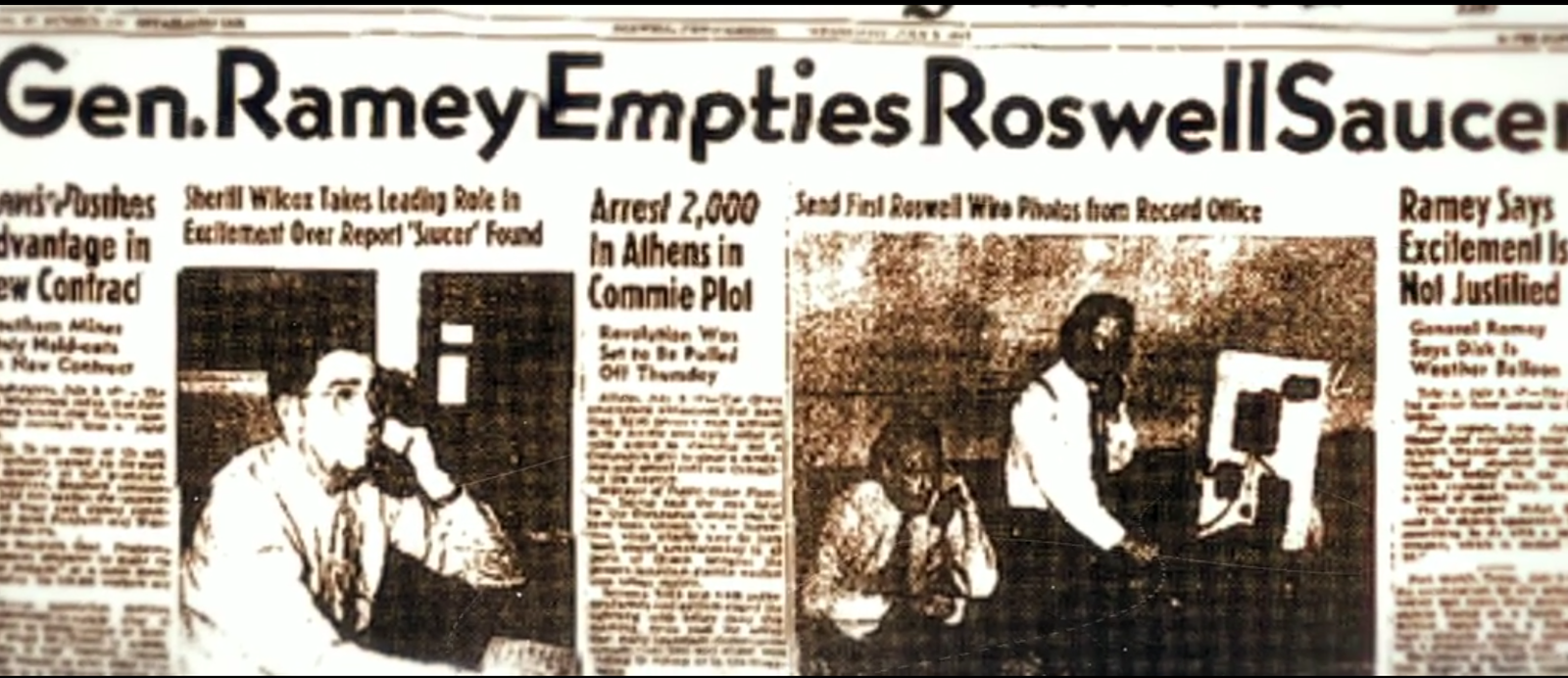
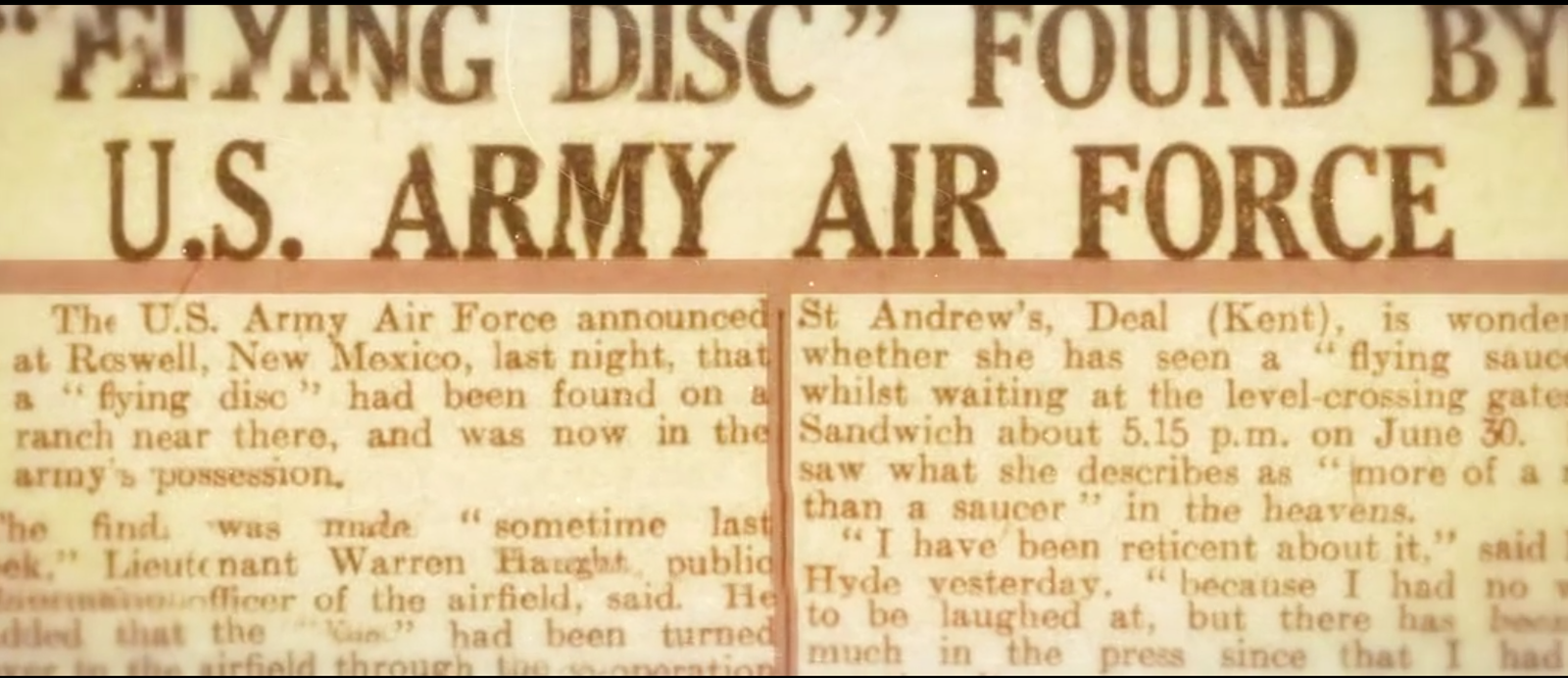
Anyone who wants to know more about which Air Force base it was and why, after three days, the news suddenly knew nothing more about it, I recommend the film Unacknowledged from 2017 by Steven Greer, which can currently be found on Amazon Prime. English with German subtitles. Just so much: the news blackout was an idea of President Truman, and I am quite sure that no one has lifted it to this day.
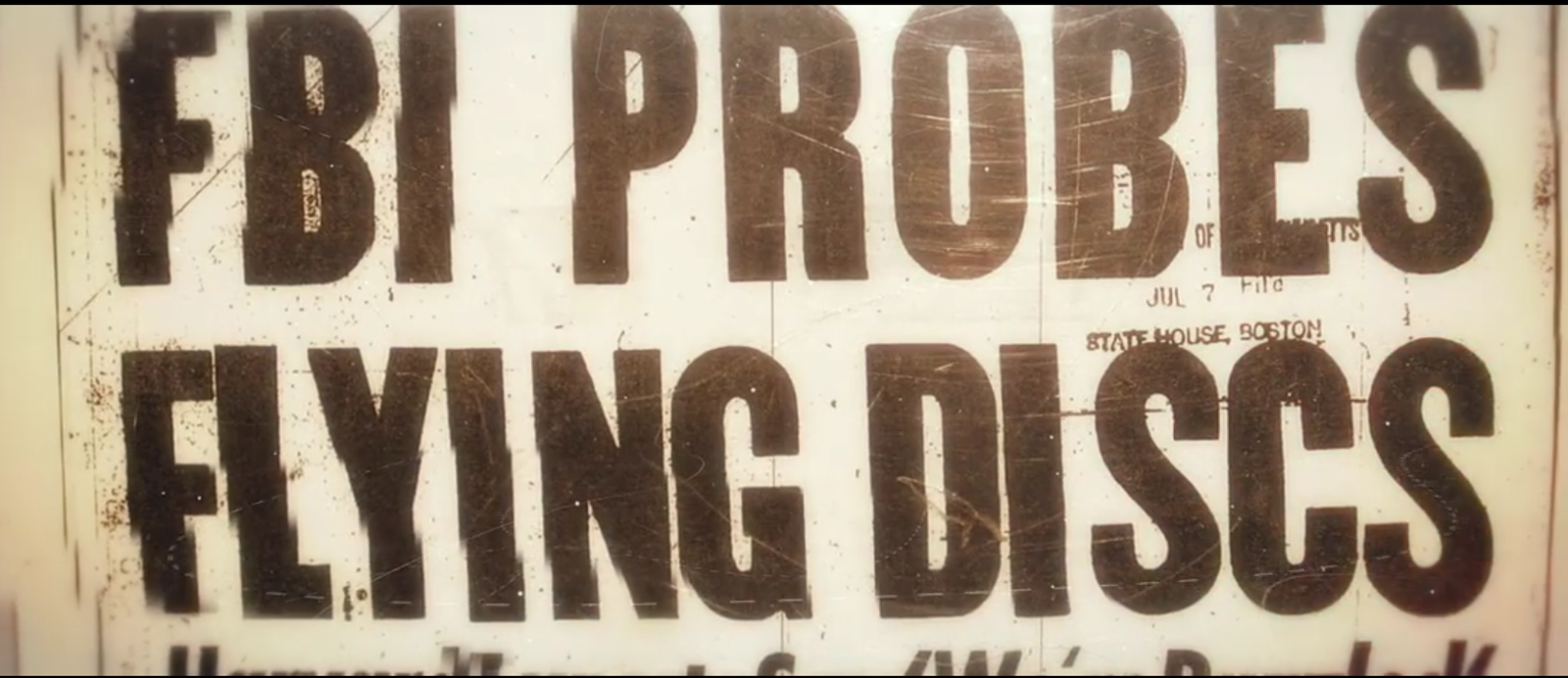
Let’s briefly turn to the FBI, which quickly showed interest in the story; even that made it into the newspapers back then…
The report that the FBI then wrote is interesting.
You can also find it online on the FBI homepage under the keyword Gui Hottel.
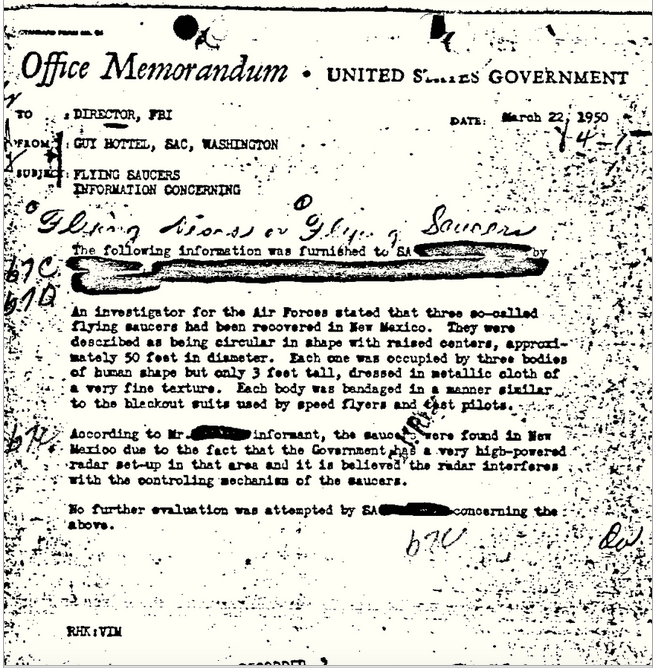
If we translate this text, it says:
To the Director of the FBI on March 22, 1950
from Gui Hottel, SAC, Washington
Subject: Flying Saucers Information on this
The following information was provided by SA ???
An investigator from the Air Force reported that three so-called flying saucers were recovered in New Mexico. Their shape was described as round with a bulge in the middle, approximately 15m in diameter. In each, three bodies were found that had a human form but were only about 1m tall. Their clothing had a metallic color and was of very fine structure. Each body was bandaged, similar to the black jumpsuits used by fast flyers (a type of parachuting).
According to the informant of Mr. ???
the saucers were recovered in New Mexico due to a very powerful radar system in the area; it is believed that the radar disturbed the control mechanisms of the saucers.
End of translation – So much for our guests from space who stranded here in 1947. Today in the original text or the most well-known text on the subject. If we now want to see how the story continues, we must go to Colonel Corso. Let’s see what he has to say. In an interview, Corso mentions the three most important things he retrieved from the Roswell UFO:
1 integrated circuits (microchip)
2 lasers
3 fiber optics
It should be noted that, for example, fiber optic cables were already known in the 19th century, but it was only through Roswell that it became clear that they needed to be insulated; the problem was always that information was lost at the first curve. It was already possible to go straight before. It is similar with integrated circuits; yes, there were already attempts at this in the 1920s, but they did not work. If you give a Stone Age person (if there ever was one) an Apple laptop, what will he do with it? Well, maybe he will kill a bear or a fox, which is smaller, but he certainly won’t write a letter with it. Why would he?—without the Internet. Only what a person already knows, for which there is already a suitable environment, or of which he at least has some idea, only with such information can we make something useful. Presumably, there are still many things in these UFOs that we simply do not understand yet.
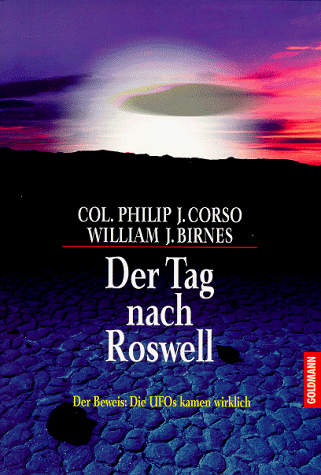
In addition to the three mentioned above, he lists in his book “The Day After Roswell” on pages 49-50 ff. (page reference according to the English original) several more. Night vision devices, electromagnetic propulsion, particle beams (Star Wars lightsaber), portable atomic generators, among others, and how UFO technology slowly became PCs, Corso can tell.
General Trudeau sought scientists who worked in the state defense industry, people like Werner von Braun, one of the SS officers who came to the USA in Operation Paperclip after World War II, or John von Neumann. An important contact was Dr. Robert Sarbacher; he was responsible for research and development under President Eisenhower. The Roswell technology was then examined by government laboratories. Dr. Wilbert Smith was responsible for telecommunications in 1950; he had influence on the government of Canada.
Each of these scientists had connections in the defense industry. General Trudeau also had contacts with the companies that manufactured and developed weapons. The companies were Bell Labs, IBM, Monsanto, Dow, General Electric, and Hughes.
General Trudeau secured the budget at the Pentagon; the training for the military was in Fort Belvoir and elsewhere.
And Roswell was not the only incident; there were over 100 UFO crashes alone in the area of New Mexico. And so extraterrestrial technology was slowly integrated into earthly research and industry until the giant machines of Zuse and Alan Turing became small, handy laptops and mobile phones.
In software development, I cannot tell UFO stories, but I can describe the three founding figures, two of whom are actually just opportunists. Bill Gates and Steve Jobs each found their way to make money with their ideas; one by building an open system, which would have been a good idea, but since around 2014, this system has been used to spy on the population, the other by building a castle that one can only buy into at a high price. The only one who, alongside Alan Turing and Zuse, belongs to the honor of the altars of earthly technological development is Linus Torvalds, the founder of Linux. Creating an operating system that is freely accessible to everyone, which today forms the basis of the Internet and nearly every mobile phone in the world, as even Apple phones consist of 60% Linux software.
To every man and woman who wants to move in the alternative scene, I can only recommend buying their computers online, specifically without an operating system, and then downloading a Linux system for free. I recommend Ubuntu, creating a bootable USB stick, which can be done with software like Unetbootin, and thus creating your own PC. Anyone who has never done this can find a friend or buy a laptop with Linux; they are rare, but they exist. The selection of devices is then very limited. Anyone who wants to keep their PC longer should also avoid gaming PCs. In the gaming scene, one can see the new developments. But those things are like toys; they break very quickly. A stable office PC lasts ten times longer, and it is also cheaper.
By 2026, a PC should have at least 8 GB of RAM if you do not want to wait forever for every task. Which brand you choose is quite irrelevant; they come and go. Asus is good, HP is cheaper, Acer is good for beginners. But make sure there is a way to store data on the device. Some devices only have a very small storage capacity; you can’t fit more than the operating system on them. Then you have to constantly pay rent for online storage, so forget that. The new devices mostly have NVMe hard drives built in. With 512 GB of storage, you will be fine. 256 is still okay, 128, which most phones have today, is about the lowest limit. Anyone who wants to store large amounts should consider the old HDD hard drives; they last longer than the new NVMe drives. Desktop PCs and servers still operate with them. The question of the processor is also important: AMD or Intel? A Raspberry Pi is only for true tinkerers. For normal users, there are only the two. I highly recommend AMD Ryzen PCs. For quality differentiation, 3, 5, or 7, which both Intel and AMD use, simple comparisons can be drawn. 3 is a bicycle, 5 is a car, 7 is an airplane (and 9 is a rocket, but no one can afford that anyway). Or 3 is very slow, 5 is okay, and 7 is already quite fast.
Robert Noyce, the founder of Intel, cannot be found in Colonel Corso’s book, but he is listed as a co-inventor of integrated circuits on the Internet. So we are certainly back in the world of secrets, just after Corso’s service time. Corso was in the US Army from 1942 to 1963; Intel was not founded until 1968. From computer science circles, I know the story that one can access an Intel PC through its processor; thus, a combination of Intel and Windows is like an invitation to the CIA, NSA, and whatever they are called to say hello in your living room and take a look at your data. I do not know such stories about AMD. And since the invention of Ryzen, AMD PCs are even faster than those from Intel. Although that is of course not important… but it is cool.
If anyone has questions, whether about computer history or general PC everyday life, feel free to leave them in the comments.