
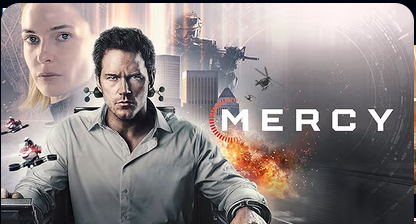
The film itself is unusual because the main actor does not move from his chair for over an hour. But from his chair, he directs the whole city as he fights for his life. Accused of murdering his wife – which he did not commit – he has to prove his innocence in one and a half hours, exactly the length of the film, and his judge is an AI. And this AI has made a mistake, that much can be revealed, even though its conclusions are absolutely logical and correct. Towards the end, it becomes a fierce action film; why and how is not revealed.
The message of the film is clear and absolutely important in our time when AIs are slowly becoming the everyday helpers for all of us. Everyone has chatted with an AI at some point. So, anyone who regularly sits at a computer, the various AIs are everywhere today. And Mercy dramatically shows what happens when one places unconditional trust in an AI. At the very end comes the one sentence that is truly wise, so let it be quoted here: We all make mistakes, and we all have to learn, humans just like AIs.
That’s what matters. We must not simply accept the judgments of AIs just because they throw around data like a scholar. Let me put it this way. The Earth was once a flat disc, and Galileo Galilei was laughed at. Einstein opposed quantum physics, and Niels Bohr’s theories could not be proven for over 100 years. In fact, it was only achieved a few weeks ago. It was about the question of whether wave-particle duality is absolute (Niels Bohr) or whether light, when it appears as a particle, is still a wave (Einstein). A layperson often cannot distinguish who is right. And it is exactly the same with AI. It throws around facts, but whether the result is right or wrong is often not easy to determine from the outside. Therefore, the same must apply to AI judgments as to human judgments. They can be right but also wrong. Do not forget, the AI can only access digitally available data; everything that is analog remains hidden from it.
I found the piece on Amazon Prime-