
We constantly talk about progress, digitalization, energy transition, artificial intelligence, and new technologies. Yet another question is surprisingly rarely asked:
What solutions and inventions already exist – and why do some of them never make it into our everyday lives or only do so decades later?
Around the globe, researchers, engineers, companies, and private inventors are working on solutions for energy, water, mobility, agriculture, health, and new materials. But a good idea alone does not change the world.
An invention must be developed, financed, tested, approved, produced, and finally made affordable for people. Often, there is a long and difficult path between a functioning prototype and a technology used millions of times.
Why do good ideas sometimes end up in the drawer?
Anyone developing a new technology often requires significant financial resources. Patents cost money, prototypes must be built, independent tests conducted, approval processes passed, and production facilities financed.
In addition, there are existing economic interests.
Companies have invested billions in existing technologies, production facilities, and supply chains. A new technology can challenge existing business models. This does not automatically mean that innovations are deliberately suppressed. But it does mean that we should ask questions:
Who finances innovations? Who owns the patents? Which technologies are further developed after company acquisitions – and which disappear? Which legal regulations promote innovation and which hinder it?
And above all:
Who benefits from a new technology – and who could lose an existing business because of it?
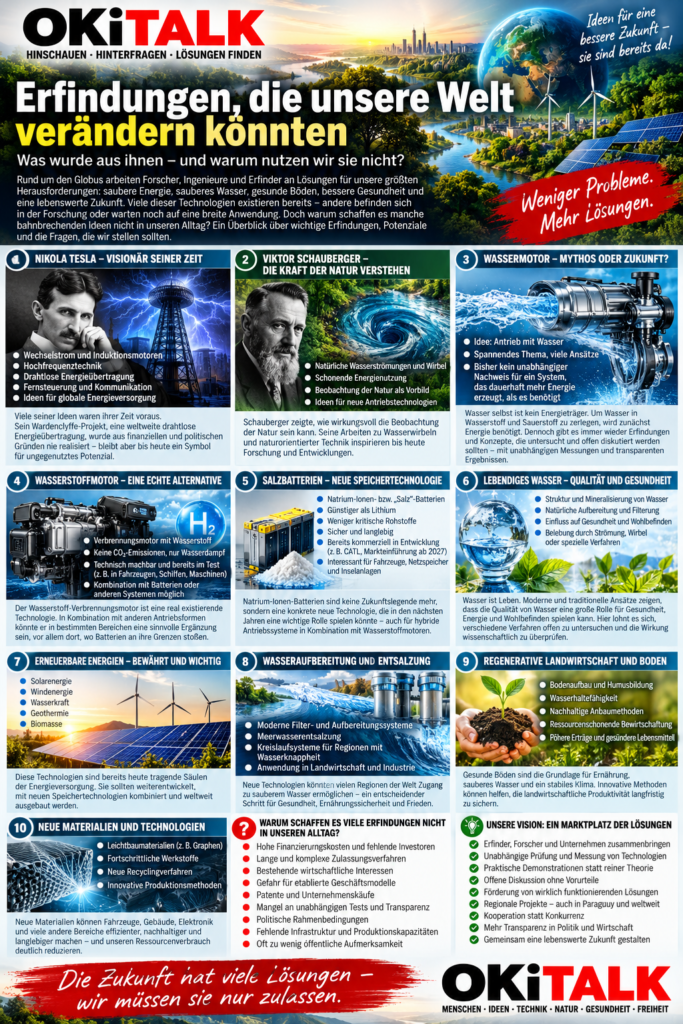
Nikola Tesla – a visionary of his time
Nikola Tesla impressively demonstrates how far ahead technical visions can be of their time.
Alternating current technology, induction motors, high-frequency technology, remote control, and experiments in wireless energy transmission are part of his life’s work.
Tesla dreamed of transmitting energy and information wirelessly over great distances. However, his famous Wardenclyffe project was never completed as a global energy supply system.
To this day, Tesla symbolizes an exciting question:
What technical possibilities do we still not recognize today because they do not fit into our existing systems?
Viktor Schauberger – learning from nature
Viktor Schauberger also engaged intensively with water, currents, vortices, and natural cycles.
His fundamental idea was fascinating: technology should not constantly work against nature but should try to understand and utilize its principles.
Not every claim later associated with Schauberger is scientifically proven. Nevertheless, it is worthwhile to reconsider his thoughts on water movements, vortex technology, and nature-oriented constructions and to experimentally verify them.
Water motor – myth or undiscovered possibility?
For decades, reports about so-called water motors have emerged.
Here we must distinguish carefully.
Water itself is not a fuel according to today’s physical understanding. To split water into hydrogen and oxygen, energy must first be applied.
However, if an inventor claims that a new process has an extraordinarily high efficiency or unlocks a previously misunderstood process, our reaction should be neither blind faith nor immediate rejection.
The right response would be:
Show us the machine. Let independent experts measure it. Publish the results.
If it works, we need to talk about it.
If it does not work, we must also accept that.
Hydrogen motor – already real technology
With the hydrogen motor, we are on much more secure ground.
Hydrogen can be used in both fuel cells and combustion engines. Manufacturers and research institutes are already working on corresponding drives.
Particularly interesting could be hybrid systems in the future: hydrogen combined with electric motors, batteries, and intelligent energy storage systems.
The crucial question is not only whether something works technically, but whether the entire energy path can be designed efficiently, affordably, and resource-conservingly.
Salt batteries – a new generation of energy storage
Sodium-ion batteries, often simplistically referred to as salt batteries, are increasingly becoming a serious alternative or complement to lithium-ion technology.
Sodium is significantly more readily available worldwide than lithium. Such storage systems could play an important role, especially in stationary systems, power grids, and possibly also in certain vehicle applications.
So why not think further?
Hydrogen, electric motors, and new battery technologies could be combined if they result in technically and economically sensible systems.
Living water – what does water quality really mean?
Water is the basis of all life.
In addition to classical water purification, there have long been discussions about mineralization, natural water movement, vortices, structuring, and various treatment processes.
Here, we should clearly distinguish between scientific findings and further-reaching claims.
Yet here too, the rule applies:
Investigate instead of hastily condemning.
If a process promises health or technical benefits, those benefits should be measurable under controlled conditions.
Water treatment and desalination
While we talk about future technologies, millions of people suffer from a lack of access to clean drinking water.
New filter systems, more efficient seawater desalination, closed water cycles, and decentralized treatment plants could therefore gain enormous societal significance.
Here, it becomes clear that technical progress does not have to look spectacular to improve the lives of millions of people.
Regenerative agriculture and healthy soils
Agriculture is also technology.
Humus formation, water-retaining soils, biological cycles, intelligent irrigation, and resource-conserving cultivation methods can help connect food production and environmental protection.
A healthy soil stores water, binds nutrients, and forms the basis of our nutrition.
Perhaps part of our progress lies not in controlling nature more and more – but in understanding it better again.
New materials and further future technologies
Graphene, new composite materials, recycling processes, modern energy storage, new production methods, and numerous other developments could make vehicles, buildings, and electronic devices more efficient and durable.
The crucial question is:
How can we bring functioning innovations faster from research and workshops into practical application?
Why do some inventions fail?
The reasons can be very diverse:
lack of capital, high development costs, complicated approval processes, lack of production capabilities, missing infrastructure, patent rights, economic interests, or simply a technology that does not prove to be as good in independent tests as originally assumed.
Therefore, we need openness and verification.
Not every extraordinary claim is automatically true.
But an extraordinary idea should not be dismissed solely because it challenges existing notions.
A marketplace of solutions
Perhaps we need something completely practical:
A marketplace of solutions.
Inventors bring their prototypes.
Researchers and independent experts verify them.
Entrepreneurs consider how they can be produced.
Investors can finance functioning projects.
Citizens can get to know them.
And independent media make them public.
Not just PowerPoint presentations and promises.
The technology should show on-site what it can do.
This could even be a model for Paraguay: bringing people from different countries together and practically demonstrating water technologies, energy systems, agriculture, new materials, and other solutions.
A simple rule should apply here:
Show us that it works.
If it works, we then ask the next question:
Why are we not using it yet?
Perhaps some solutions to the problems of our time already exist. Others still need to be developed. And some supposed miracle technologies will not withstand independent scrutiny.
But we will only find out if we remain open, verify, research, and talk to each other.
Progress does not arise from constantly talking about what is impossible.
Progress arises from people who ask:
What is possible?
The future has many solutions – we must be ready to seek them, verify them, and also allow functioning ideas.
OKiTALK – look closely. Question. Make solutions visible.