
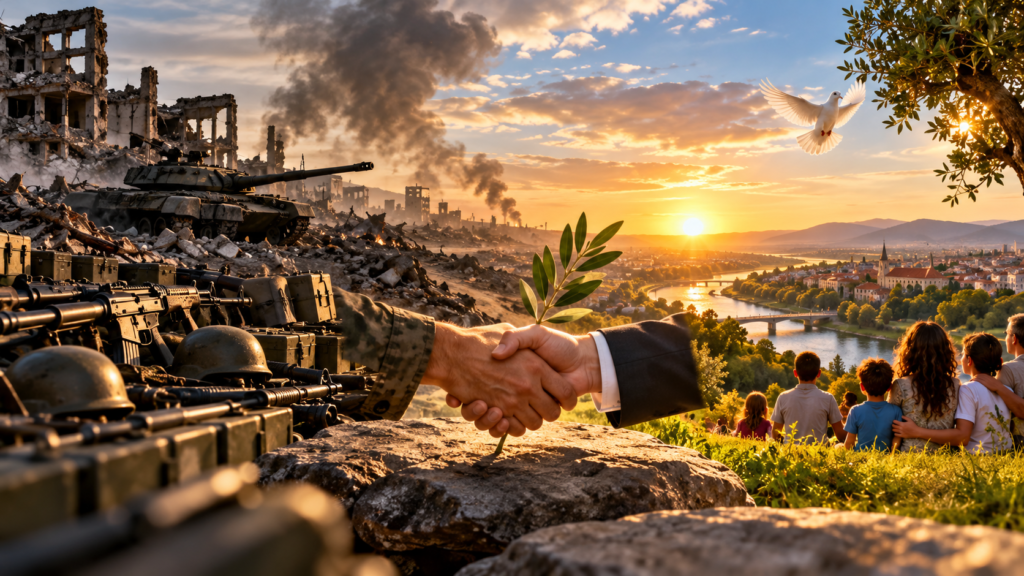
How well is the world equipped for peace?
We live in a time when there is again a lot of talk about rearmament, weapons, deterrence, military strength, and war. Billions are spent on tanks, rockets, ammunition, and new weapon systems. At the same time, people in various regions of this earth are experiencing firsthand what war actually means: dead and injured, destroyed cities, traumatized children and adults, lost homes and livelihoods.
Therefore, we should ask a simple but perhaps crucial question:
If the world is so excellently equipped for war – how well is it actually equipped for peace?
Peace begins with diplomacy
Diplomacy does not mean weakness. Diplomacy means talking to each other, especially when positions are far apart.
Peace rarely arises from two sides being of the same opinion. Peace arises rather where different interests exist and people remain willing to negotiate with each other.
The goal must therefore always be:
Prevent escalation, keep channels of communication open, and seek solutions before people die.
Negotiations are not a sign of capitulation. They are among the most important tools of a civilized society.
Weapons create security – or danger?
States justify military rearmament with defense and deterrence. This argument is part of an honest discussion.
But the other side is equally relevant:
The more weapons that exist on our planet, the greater the potential for their use, transfer, miscalculation, or escalation.
Weapons can deter. But they can also create distrust and trigger an arms spiral: One side re-arms, the other feels threatened and also re-arms.
Therefore, we must not only ask:
How many weapons do we need for security?
We should also ask:
How much diplomacy do we need so that these weapons never have to be used?
Interests lie behind wars
Wars do not arise out of nothing.
Territorial claims, raw materials, geopolitical power, economic interests, historical conflicts, ideologies, security interests, and mutual perceptions of threat can all play a role.
Additionally, there is an international arms industry associated with enormous economic interests.
This does not mean that every arms manufacturer wants war. But it is legitimate to ask what influence economic interests have on political decisions.
Who profits from rearmament? Who profits from reconstruction? And who ultimately pays the highest price?
The highest price is almost always paid by people.
War destroys what generations have built
A house can exist for decades and be destroyed within seconds.
A city can grow over centuries and be in ruins within months.
But the worst damages cannot be measured in money at all.
A killed person cannot be rebuilt.
A lost childhood cannot be replaced.
Traumas can accompany people and families for generations.
Therefore, war is ultimately destruction of life.
We invest enormous resources to build something – and then again enormous resources to destroy it and then rebuild it.
The question must be allowed:
Can we not use our intelligence better?
Money cannot be eaten
Economy and prosperity are important. People need income, housing, infrastructure, and economic security.
But money is not an end in itself.
In the end, a person needs clean water, food, a home, health, community, education, security, and the opportunity to shape their life autonomously.
A successful society should therefore not only be measured by how large its economic output is or how strong its army is.
It should also be measured by:
How well can people live there?
Politics must serve life
Politics carries enormous responsibility.
It must represent different interests, ensure security, and sometimes make difficult decisions.
But above all strategic considerations, one question should prevail:
Does this decision serve life and a more peaceful future?
If diplomacy fails, our reaction should not be to abolish diplomacy.
We should ask how we can improve it.
Perhaps we need, alongside defense budgets, something that is talked about much less:
a peace infrastructure.
More professional mediators. More direct communication channels between conflict parties. More international encounters. Early conflict prevention. Independent mediation. Exchange between populations. And diplomats whose success is measured by which escalations they have prevented.
From opposition to cooperation
We do not all have to have the same opinion.
People, states, religions, and cultures will always have different interests.
Peace does not mean equality.
Peace means finding a way to live with differences without destroying each other.
Perhaps we need to change our most important question.
Not:
How do we win the next war?
But:
How do we prevent it?
Humanity today possesses technologies, knowledge, and possibilities that previous generations could only dream of.
We can connect people across continents within seconds. We can treat diseases, send satellites into space, and develop artificial intelligence.
Then we should also be smart enough not to want to solve conflicts repeatedly with destruction.
Peace does not begin after the war. Peace begins before the war – with conversation, respect, diplomacy, and the will to de-escalate.
Perhaps that is the greatest task of our time:
Not always being better equipped for war – but finally being better equipped for peace.
OKiTALK – look closely. Question. Talk to each other. Find solutions for life.