
What is history, what is myth – and what is personal perception?
Greece is one of the great cultural areas of Europe. Its mythology, philosophy, language, and history continue to have an impact far beyond its borders to this day.
In this OKiTALK broadcast, Aurena Agathe Fohler takes us to Rhodes. She has been living in Greece for some time and travels to various islands. In doing so, she engages not only with sights but also with their history, symbolism, and her personal spiritual perception. Right from the start, she describes Greece as an extraordinary cultural heritage.
An island full of history
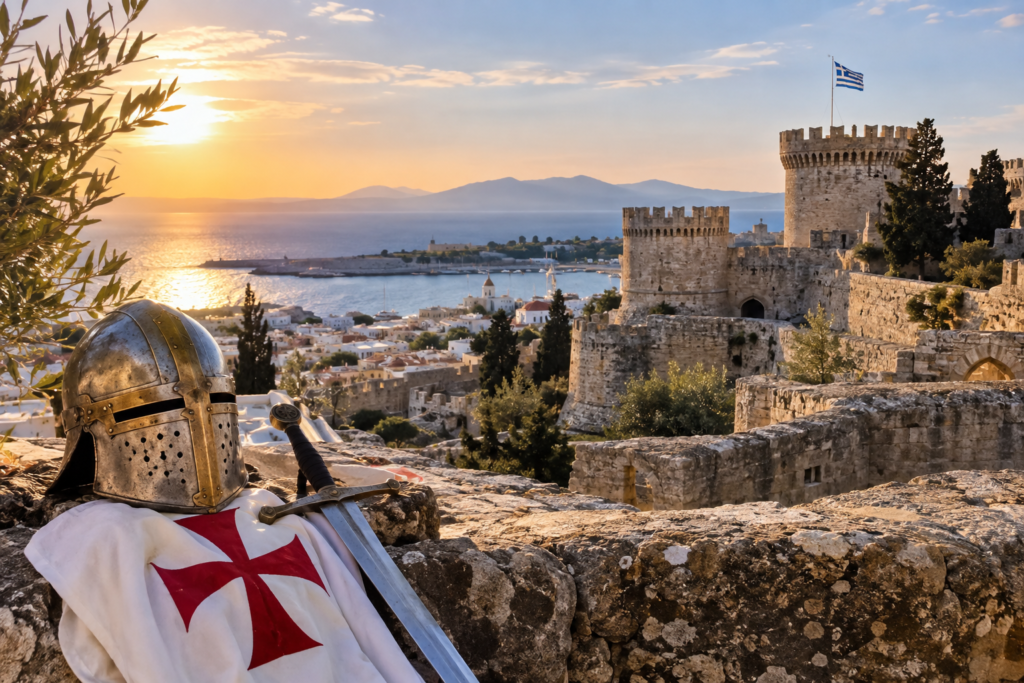
Rhodes impresses with massive fortifications and a long history. Aurena shares her personal impressions of the island and guides the viewers through images and experiences from her journey.
In the process, she encounters traces of the knightly orders and engages with, among others, the Hospitallers and Templars. In the broadcast, she connects these historical elements with further spiritual interpretations.
The legendary Colossus of Rhodes also serves as a starting point for questions about Helios, Athena, and the significance of ancient Greek symbols.
Athena and the female power
Aurena is particularly preoccupied with the search for a temple of Athena. For her, Athena represents not only a figure of Greek mythology but also wisdom, strength, and female power.
She reports how she eventually found a largely destroyed temple on a hill in Rhodes and perceived this place quite differently than parts of the tourist-influenced city.
From there, the conversation develops into a larger question: What role did women play in past cultures – and how were female and male principles represented throughout history?
Dragons, Atlantis, and hidden worlds
The broadcast goes far beyond classical historiography.
Aurena connects Greek myths with ideas about dragons, Atlantis, energy, consciousness, and extraterrestrial life. These statements are her personal or spiritual interpretations and are not presented in the broadcast as historically or scientifically substantiated.
However, this leads to an interesting question:
Where does historical tradition end, where does mythology begin – and what value can personal or spiritual interpretations have for a person?
Aurena herself encourages the viewers not to simply accept information but to think for themselves, research, and question things.
The healthy ego and togetherness
Another interesting thought arises with the Greek word ego.
Aurena does not interpret the “I” fundamentally negatively. A healthy ego can rather be a prerequisite for encountering other people on equal terms – without losing heart and togetherness.
Thus, the journey through Greece ultimately leads to a very contemporary question:
How do we manage to not constantly use differences as a reason for opposition, but instead come back to a dialogue with each other?
This is exactly what OKiTALK stands for: making different thoughts audible, asking questions, discussing together, and not just allowing the viewer to consume.
Participate instead of just listening.
🎥 The complete broadcast:
Rhodes – the island of dragons and knights – https://youtu.be/ulHBmqQtM9s