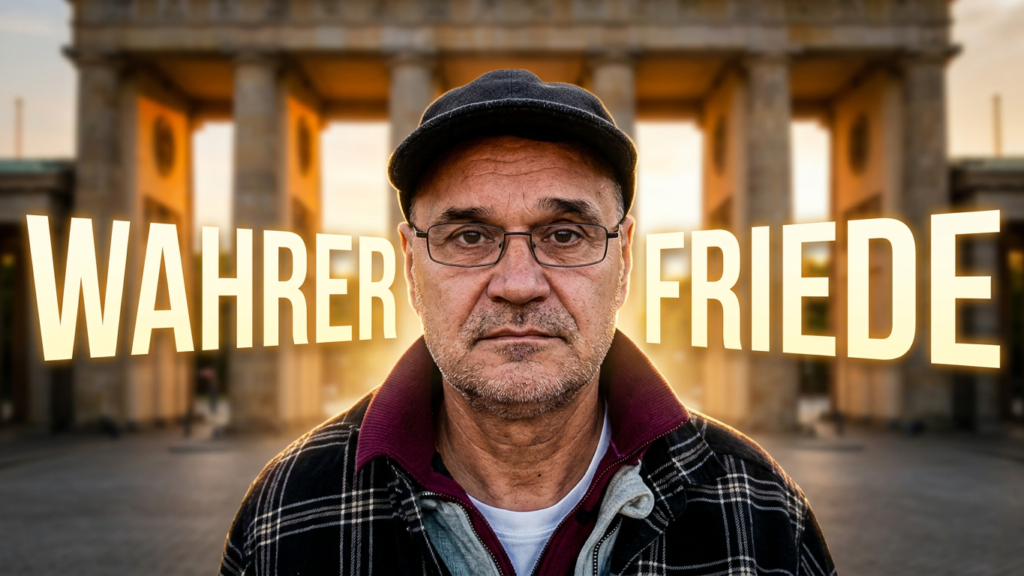
How do I stay free when the world wants to pull me into camps?
A personal reflection on the Monday conversation from September 14/15, 2026 at the Brandenburg Gate
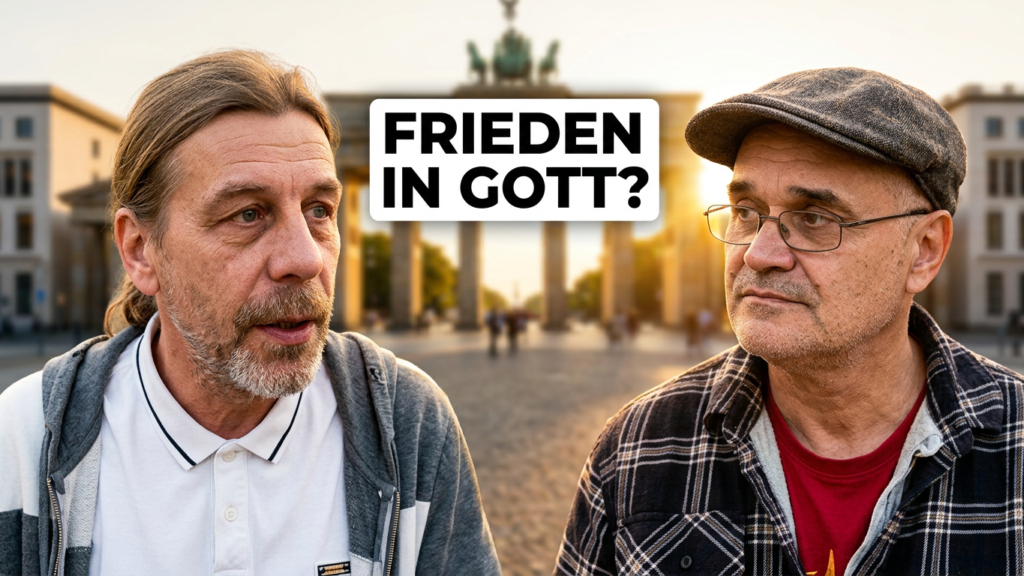
Introduction – Thank you for this conversation
I am grateful. That I was allowed to express this. That we were simply allowed to talk at the Brandenburg Gate – two people from two worlds, Berlin and Paraguay, without a script, without a teleprompter, with motorcycles in the background and a microphone that sometimes is off.
The conversation was not an interview. It was a Monday conversation. Stream of Consciousness. Self-reflection. And that is exactly why it is worth evaluating it again. Not to be right, but to invite: Think along. Examine your own worldview. Just as I examine mine.
The title was: The world comes to us.
What was it about?
Uwe came with a handout: What does Germany mean today? What connects, what divides? What role do faith and conscience play? How to speak when opinions diverge? Where does peace begin?
The hook was touching: An older gentleman paints signs – political messages, behind them anger and the desire for liberation. He wished for classical music to accompany it. Uwe created a symphony with AI: “The world comes to us and it is entrusted to us.”
The image has not left my mind. We are guests. Stewards, not owners.
[Image: Kitchen table – where politics begins] Great politics begins at the kitchen table.

The strongest thoughts
1. The kitchen table
“Great politics begins at the kitchen table.” That is the sentence of the show. Family, true friends, how do I speak at home? If I condemn or expose there – how am I supposed to make peace outside?
2. Thought hygiene
What do I think, what do I say, what do I do? We have learned rules by heart, but we no longer feel: I am here. I breathe. Ground under my feet. This is not esotericism. This is arrival. Without arrival, no peace.
3. Conscience is not the same as feeling
Conscience must be formed. Otherwise, one can also shoot with “conscience.” Uwe clearly distinguishes between emotion and educated conscience – and honestly admits his own mistakes.
[Image: Light in the twilight at the Brandenburg Gate]
4. Truth as a question
Truth occurs when I can question what I consider to be truth myself. That is the opposite of camp thinking.
5. Freedom needs limits
Freedom does not mean being able to do anything. Freedom means: I can die for God and am free. And very practically: Start with a piece of sugar.
The critical points – honestly illuminated
I do not want to exclude them, but rather formulate them as an invitation:
- How do we talk about groups without condemning ourselves what we criticize in others?
- Where does justified discomfort end and where does resentment begin?
- How do we distinguish between institution and person, between knowledge and attitude?
A beautiful moment was the loving contradiction between the conversation partners regarding religions: Claiming absoluteness as testimony, not as a claim to power. Carrying light without shoving it in the other’s eyes.
What carries me in the end
Uwe’s closing words: Faith, hope, love. My seed. What others do with it is their business.
And the simple sentence that remains:
I examine my conscience. I seek the truth – even against my own worldview. I do not let myself be determined by the hatred of the other. I respect his dignity without having to adopt his opinion. I take responsibility for my own decisions. And as a Christian, I set my gaze on Christ, of whom I believe: I am loved and accepted. From this, peace can arise.
[Image: Endcard – Guiding thought of the conversation]
Invitation
I invite you not to agree. But to think. To research. To read about Father Franz Reinisch. Romans 2:14–15. Catechism 1776–1785. John 8:32. Philippians 4:8.
And tomorrow morning: a small piece of freedom. Washing dishes in peace. Giving a glass of water. A breath: I am here.
Peace does not begin on the big stage. It begins at the kitchen table.
God’s protection and blessing on all paths.
Dates: Every Monday 5:30 PM – Monday conversation live at the Brandenburg Gate Every first Saturday of the month – Rosary men’s prayer in Berlin (open to all)
Recording from September 14, 2026 | Publication: September 15, 2026
Topic: “The world comes to us”
What do we do with this world that is entrusted to us for a limited time?
This Monday conversation asks about conscience, truth, human dignity, freedom, responsibility, faith, and peace – and how we can remain in conversation with each other despite differing opinions.
The catechism grounds the dignity of man in his creation in the image of God (CCC 1700 ff.).
CONSCIENCE AND TRUTH
According to Catholic understanding, conscience is a judgment of reason about the moral quality of a specific action. It must be formed and oriented towards truth, reason, and God’s word (CCC 1776–1802).
Therefore, the formation of conscience includes the willingness to examine oneself:
Am I really seeking the truth – or just the confirmation of my own opinion?
Can I be wrong and contradict myself without devaluing the other?
FATHER FRANZ REINISCH
A historical example is the Pallottine Father Franz Reinisch. He refused to take the oath of allegiance to Adolf Hitler for reasons of conscience and was executed on August 21, 1942, in Brandenburg.
The Pallottines refer to him as the only Catholic priest who refused the oath of allegiance to Hitler. His beatification process was opened in 2013; the diocesan investigation in Trier was completed in 2019. The process continues in Rome.
His testimony is not meant to equate the Nazi era simply with the present. Rather, it poses the fundamental question:
What happens when a person is convinced that they must obey God and their conscience more than a human power?
THE TEN COMMANDMENTS
The Ten Commandments are viewed as a question for our present. Jesus does not simply abolish them but leads them to fulfillment in love for God and neighbor (CCC 2052 ff.).
How do we want to live together?
FREEDOM AND RESPONSIBILITY
Freedom also means taking responsibility for one’s own thinking, speaking, and acting.
I can set boundaries without exercising violence. I can disagree without hating. I can say no without dehumanizing the other.
I am responsible for my own actions – not for controlling the heart or reaction of another person.
PEACE BEGINS AT THE KITCHEN TABLE
Great politics also begins at the kitchen table.
How do we talk to each other? How do we deal with those who think differently?
The catechism understands peace not only as the absence of war. Peace is connected with justice, human dignity, brotherhood, and love; peace is also the fruit of the peace of Christ for Christians (CCC 2302–2306).
Peace does not mean indifference. Peace means: truth without hatred.
THE LOOK UPWARD
I can say what I believe and point to Christ. What the other makes of it is not entirely in my hands.
“YOU ARE LOVED”
Perhaps this is the simplest sentence of this Monday conversation:
You are loved.
As a Christian, I believe: Man is created by God and therefore possesses dignity. This applies also to the person who believes, doubts, or thinks differently.

MY SEED IS HOPE, FAITH, AND LOVE
My seed is hope, faith, and love.
I want to pass it on.
What the other does with it is their business.
I cannot decide that.
I can decide what I sow myself:
Hatred or peace. Contempt or dignity. Fear or hope. Lie or truth.
And as a Christian:
Jesus Christ.
BIBLE AND CATHOLIC FOUNDATIONS
Genesis 1:26–27 · Exodus 20 · Leviticus 19:18 · Matthew 5 · Matthew 22:37–40 · John 14:6 · Romans 12:18 · 1 Timothy 2:4
CCC 1700 ff. – Human dignity · CCC 1776–1802 – Conscience · CCC 2052 ff. – Ten Commandments · CCC 2302–2306 – Peace
SOURCES AND TRANSPARENCY
Foundations: Holy Scripture, Catechism of the Catholic Church, Second Vatican Council, Pallottine / Franz Reinisch Forum as well as historical sources. Additionally, the recording of the conversation from 14.09.2026 and personal experiences.
This video is a personal conversation. Personal experiences and political assessments are to be distinguished from the teaching of the Catholic Church.
No call for violence, hatred, or exclusion. The focus is on truth, human dignity, and peace.
MONDAY CONVERSATION
Regularly LIVE at the Brandenburg Gate in Berlin and other locations.
I seek the truth without dehumanizing the other.
I contradict the error without hating the person.
I allow myself to be corrected